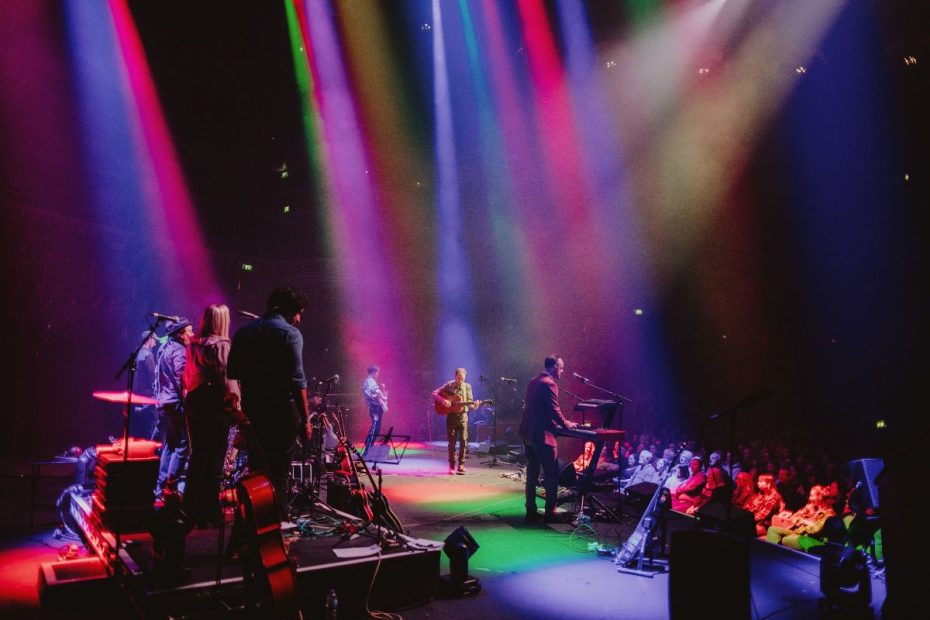
At the Royal Albert Hall, Stornoway didn’t just show their musical pedigree, they created a whole other world, an immersive fairytale of the nature around us and the memories within. A historic night and an emotional journey that I was lucky enough to witness.
In 2010, Stornoway arrived with a bang, producing one of the emotionally richest albums of the time. Since then, the Oxfordian legends have gone from strength to strength, stretching their technical prowess across a broad palette of genres and capturing the hearts of listeners across generations. It was on this fated night that their cult following culminated, coming together under the roof of Britain’s most beloved concert hall
Few buildings hold as many memories within their walls, reverberate such sentiment between their arches, and at times feel so alive as the Royal Albert Hall. As I arrived at its steps, I knew I couldn’t hold my anticipation for much longer, but as the musical tardis opened before me, the warm glow of the Hall soon felt like home.
First up on the night’s billing was Hayden Thorpe. For over twenty years, the frontman of Wild Beasts, Thorpe, now took to the stage alone, and with it constructed a performance that showed the maturity of his class.
Under an iridescent, rust-tinted spotlight, Thorpe played a selection of his solo work, interpolated with some Wild Beasts classics. Tracks that had made the group, as well as Thorpe, such an inspiration to Stornoway themselves. With the instrumentalism of a Sebastien Tellier and the vocal control of Patrick Wolf, Thorpe’s storytelling was the perfect warm-up for the night’s proceedings.
There was time for a quick drink and a sprint to the loo, but before long, the Hall chimed out. It was time for Stornoway’s entrance. An ethereal haze gathered around the stage, and a symphony of nature’s birdsong lulled through the acoustics and dimmed lights. The crowd murmured, and then, a single voice cut through. Instantly recognisable and at the same time calming.
Brian Briggs, Stornoway’s frontman, fittingly delivered Walking Song as he drifted through the crowd and onto the stage. There, illuminated under spotlit beams, was the rest of the band, plucking and tuning each note, until they began to coalesce into harmony. The familiarity of Farewell Appalachia formed, and the set slipped effortlessly into gear.
What followed was a powerhouse couple of hours filled with favourites from across their albums. Jangling from tunes that you couldn’t help but tap along to, to some of their most touching work, Stornoway were in their prime. But early on, the band showed the set would have its surprises too.
Paul Henry, the lauded poet, would be the first hidden treasure, emerging to introduce and co-perform a brace of Stornoway’s tunes. Taking excerpts from his ethereal Glass Aisle, Henry weaved his words into the band’s performance of Mary Some Nights I see you and John Moonlight. The group clustered together, transforming the vault-like hall into an intimate moment of storytelling.
Afterwards came the first interlude, and with it a lesson on the sounds of nature and birds that had been fluttering around since our entrance. It wouldn’t be a Stornoway gig without a reference to the beauty of the world around us, the eternal muse for a band so passionate musically and in their everyday life about nature.
A stand-out for me was the Lapwing, or as Brian coined it, “the synthesiser of the marsh.” A reference that instantly popped electronic artist Werkha’s, likewise named song, into my head. The Venn diagram of Stornoway’s influence and inspirations, woven interconnected throughout the musical world, perhaps without intention, but symbolic of their open minds.
The following mid-section of the set held a flurry of further surprises. The band bouncing from classics like I Saw You Blink to a live debut of new song Marco Polo and a cover of fellow Oxfordian legends The Epstein’s Leave Your Light On. Soon followed by another familiar tradition, as Brian and co. hushed the crowd for a stripped-back, unplugged version of Get Low. Few bands could turn a 5000+ towering hall into such a moment of snug simplicity, and yet they did.
As the crowd resurfaced, laughs and smiles lit up the room, greeted by one final interlude, another journey into the world of nature. This time, descending in Brian’s words to the depths of the Atlantic. Each member disappeared off stage as whalesong filled the 360-degree venue.
In that moment, time stopped, you could close your eyes and feel your body floating amongst the arches. Bellows of a whale embraced each listener, and then the trio came up for air. Gathered alone, the band, an island in the Hall’s ocean, began Josephine. But they weren’t alone. A bar or two in, and The Syrinx Choir burst into voice, illuminated alongside them.
The choir appeared without warning, a beautiful shock, building the grandeur of Stornoway’s storytelling. The collective hit its climax with the debut of River of Voices, the crowd now joining in as well. A protest song fitting for the frightening times we live in, and the perfect kickstart for the final song of regular time, Zorbing.
The Cowley Road classic had the crowd straight to their feet, arm in arm, swaying and singing, in a scene fitting of the National Portrait Gallery. The crescendo of a night few will forget.
Before an encore was kicked off by their “only hit”, as they joke, a cover of The Only Way Is Up. Followed by the insta-tear-causing Fuel Up and one final coming together in We are the Battery Human. The perfect end to Stornoway’s perfect set.
Few gigs deserve so many superlatives and so much praise, but a night like this is special. A piece of history for Stornoway and the Royal Albert Hall that will remain in the hearts of those who attended for long to come, not least the band themselves.
The post Stornoway: Hebridean Headrush hits The Royal Albert Hall appeared first on Indie is not a genre.